
Electron-Beam and Plasma Arc metallurgy are modern technologies for metals and alloys formation and purification. Our experience in these processes will allow us to manufacture specialized equipment for your demands as well as provide a research in this field.

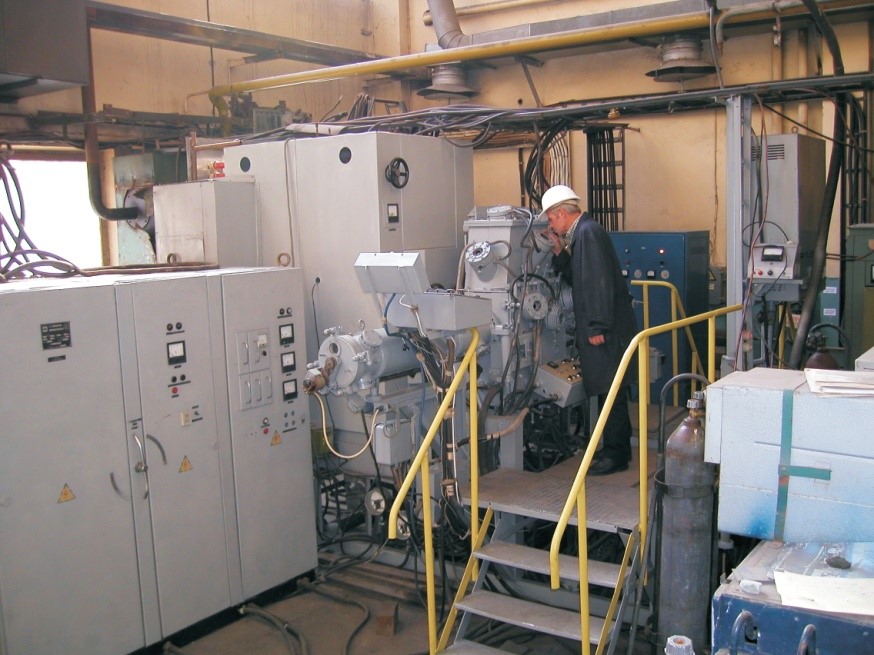
GAS-DISCHARGE ELECTRON BEAM GUNS OF THE BTP SERIES
Electron emission in gas-discharge EB gun results from the ions bombardment of cathode. Ions are emitted by plasma, which occurs in high-voltage glow discharge between cathode and anode. The initial forming of the electron beam is provided by the design features of the cathode and anodic assembly. Then by operating of focusing and deflection coils, the electron beam has been focusing on the processed surface and been scanning on it with specified frequency and path (sweep).
The special features of gas-discharge EB gun are the following:
- It does not demand separate high-vacuum pumps for the additional evacuation of the gun’s chamber. Gas-discharge EB gun can operate stable under residual pressure in the gun’s chamber at range 10…0.01 Pa.
- It is not sensitive to pressure variations in the operating chamber, to the action of metal vapor, and even spray during the running of the melting process. This feature allows stable melting of gas-saturated stock of refractory and reactive metals, for example, titanium sponge.
- It has compact construction and lightweight; it is simple and reliable at operation.
- The cathode of gas-discharge EB gun has long service life (up to 1000 hours).
- Gas-discharge EB guns have attractive prices due to using inexpensive materials for production and maintenance of them
Gas-discharge EB guns are successfully used in Ukraine, Russia, Estonia, China, Taiwan and USA for the melting of titanium, niobium, tantalum, and other materials.
Design of gas-discharge EB gun includes the following main parts and units:
- Cathode assembly (including a cathode);
- Anodic assembly;
- Insulator;
- Focus-and-scanning system (including two focusing coils and one deflection coil)
During the operation of gas-discharge EB gun, the operational gas mixture (hydrogen and oxygen in specified proportion) is supplied to the discharge chamber of the gun. High-voltage glow discharge burns in the discharge chamber of a gun under accelerating voltage between cathode and anode.
The plasma is generated under discharge and emanates positive ions, which are accelerated by electric field in the zone of the cathode. Potential drop and bombarding the cathode is causing electron emission. The same field accelerates electrons and forms a converging electron beam that passes to the focus-and-scanning system through a hole in the bottom of the anode.
The magnetic field created by the first focus coil forms an electron beam under the form close to cylindrical. Here upon it passes to the melting chamber through focus-and-scanning system practically without power losses. In the second focus coil, the beam is focused on a heating surface. Specified scanning of beam is carried out by the deflection coil.
The current of the electron beam is controlled by regulation of operating gas pressure in a gun. Special gas supply control system is applied for the efficient control of the electron beam current and stabilization of the operating mode of the gun. The control of gas supply in this system is carried out using electromagnetic regulators of gas outflow.
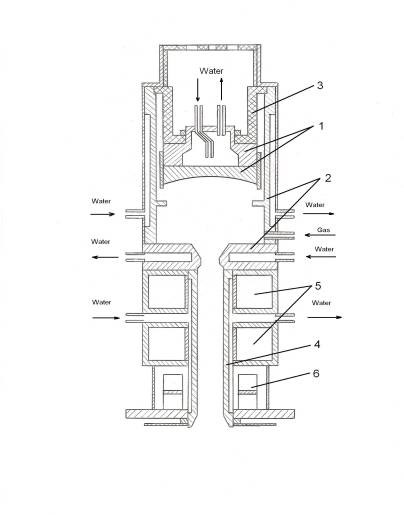
The construction scheme of the gas-discharge EB gun of the BTP series
- 1- Cathode assembly;
- 2- Anodic assembly;
- 3- Insulator;
- 4- Beam transmitter;
- 5- Focusing coils;
- 6 -deflection coil


The system for preparation and supply of operating gas mixture and gun’s cooling system consists of commercial equipment which is used for the same technical purposes.
Any unrestricted high-voltage power supply can be used if it ensures maximal protection from a short circuit. This power supply also provides rapid recovery of parameters of output current and voltage in case of a breakdown in EB gun.
Gun’s control system provides control for gas outflow regulators (in fact, it is control of beam power), control for focusing and path of an electron beam, and provide continuous automatic monitoring of EB gun parameters.